“If you want to cook Japanese food, start by buying these 15 Japanese cooking tools.”
If you read English-language guides to Japanese cooking, you will often see lists like that, featuring cooking chopsticks, suribachi mortar bowls, bamboo sushi mats, tamagoyaki pans, and other distinctly Japanese-looking tools.
They are all real Japanese cooking tools. But living in Japan, I often look at these lists and think: plenty of Japanese people do not own all of these either.
Take the suribachi, for example. It is a traditional Japanese kitchen tool, but calling it an essential in a modern Japanese home would be a stretch. The same goes for many other specialized utensils.
Ginger and garlic do not always get grated from scratch in Japan, either. Tubes of grated ginger and garlic are widely sold in supermarkets and convenience stores. Prepared grated daikon is also easy to buy. And while a rectangular tamagoyaki pan is useful if you regularly make rolled omelets or bento, you can live perfectly well without one if you do not.
So instead of listing tools simply because they look “Japanese,” I am going to judge them by a more practical question: if you live outside Japan and want to cook Japanese food, are they actually worth buying?
Quick answer: No — Japanese food does not require a kitchen full of Japanese tools. A knife, pot, frying pan, and bowls already cover most dishes. Buy specialized tools (◎ rice cooker, grater) when you notice you actually need them, and skip the rest (× suribachi, miso strainer, scum skimmer) unless you’re already a regular.
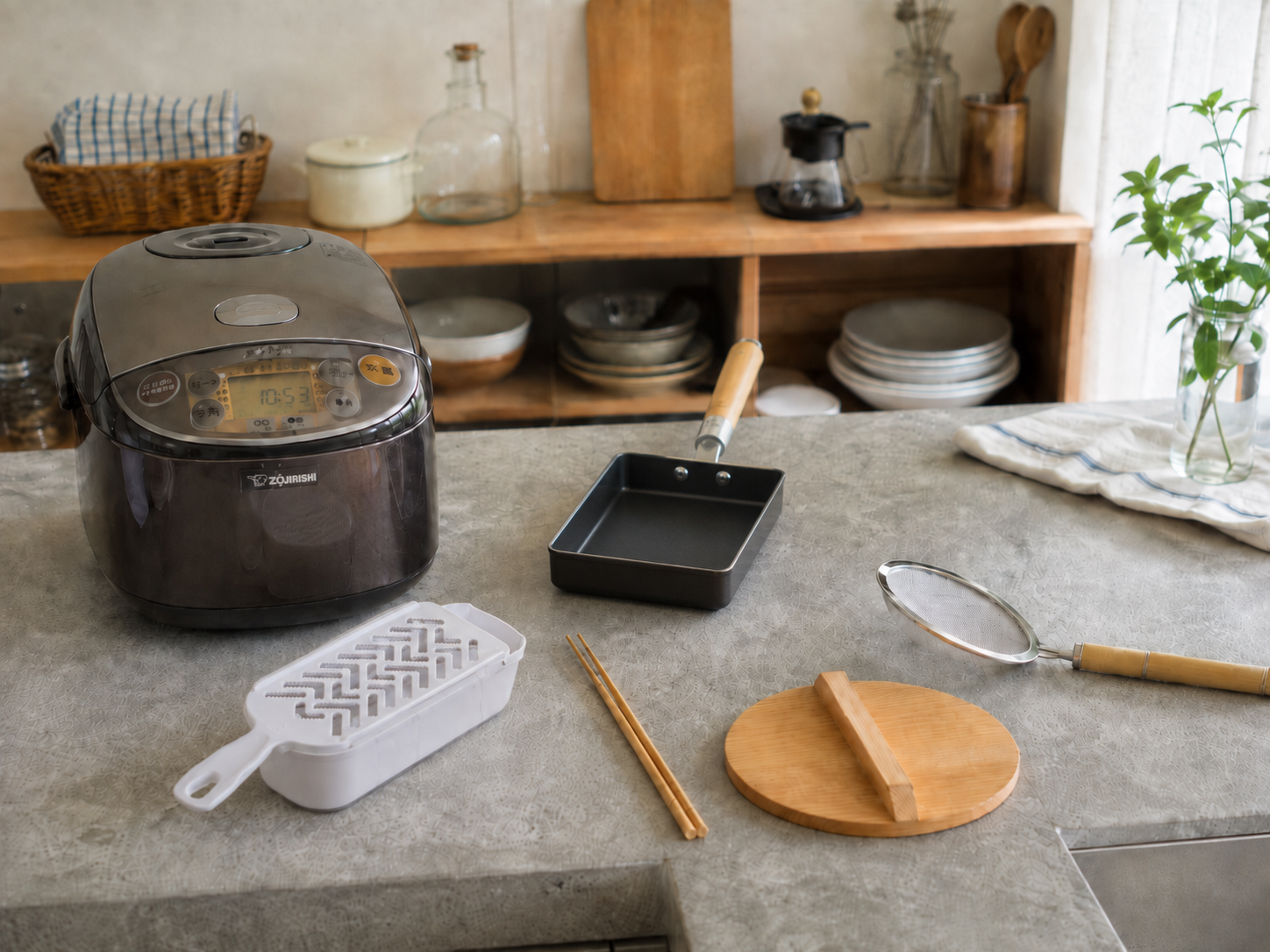
The short answer: Japanese food does not require a kitchen full of Japanese tools
You do not need to buy a complete set of Japanese cooking utensils before you start cooking Japanese food.
A knife, cutting board, pot, frying pan, mixing bowl, and tongs can already handle a huge number of Japanese dishes.
Specialized tools become useful when you start making the dishes that need them often enough to notice the inconvenience of not having them.
My recommendation is simple: start with the tools you already own, cook Japanese food, notice what feels inconvenient, and only then buy the Japanese tool that solves that particular problem.
◎ Worth buying
1. Rice cooker
A rice cooker is technically a kitchen appliance rather than a kitchen utensil. But if there is one thing that is hard to separate from everyday Japanese food, it is rice.
You can cook rice in a pot or donabe, but for a beginner, a rice cooker is by far the easiest option: measure the rice and water, press a button, and let the machine handle the rest.
If you only cook Japanese food occasionally, I would not buy one just for that. Storing uncooked rice can also be more trouble than it is worth if you rarely eat it, so packaged ready-to-eat rice may make more sense.
But if you want Japanese rice several times a week, a rice cooker may change your daily routine more than several traditional cooking tools combined.
Verdict: ◎ Worth buying if you eat rice frequently.
2. Kitchen scissors
Kitchen scissors are not uniquely Japanese.
What I do think is worth looking for is a pair that comes apart into two pieces for washing. If you use scissors directly on meat, fish, herbs, or other food, being able to separate the blades makes it much easier to clean around the joint.
In Japan, cooking videos that promote “no-knife” meals made largely with kitchen scissors have also become increasingly common.
That said, if you already own a good pair of kitchen scissors, there is no reason to replace them just because a pair is made in Japan.
Verdict: ◎ Worth considering if you do not already own a good, easy-to-clean pair.
3. Grater
A grater is useful when you have fresh ingredients on hand and want to grate a small amount of ginger, garlic, daikon radish, citrus peel, carrot, or nagaimo (Japanese mountain yam, often eaten grated as tororo).
But Japanese people do not necessarily grate ginger and garlic from scratch every time. Tubes of grated ginger and garlic are common supermarket staples, and prepared grated daikon is also available.
Personally, I use tubes for ginger and garlic, but grate daikon, nagaimo, and carrots myself.
I do not use grated daikon often, and I usually need only a small amount. Buying a ready-made pack can mean the rest expires before I finish it. Instead, I grate part of a whole daikon and use the rest for simmered dishes or pickles.
I also grate carrots for dressing. Mix grated carrot with KANTAN-SU, a seasoned vinegar made by the Japanese company Mizkan, plus olive oil and a squeeze of lemon, and you get a simple, tasty dressing. Since I cannot buy that exact mixture ready-made, grating it myself makes sense.
If tube condiments are difficult to find where you live, or you prefer fresh ginger and other fresh aromatics, a compact Japanese-style grater may be even more useful to you than it is to some people in Japan.
Verdict: ◎ Worth buying if you regularly use fresh aromatics or grated vegetables.
△ Useful, but only for the right person
4. Cooking chopsticks (saibashi)
Saibashi are long chopsticks used for cooking. They are longer than eating chopsticks and can be used to stir, turn, lift, and plate food.
One practical advantage is that their length keeps your hand farther away from the heat.
But if you are not comfortable using chopsticks, I do not think you need to learn saibashi just because you are cooking Japanese food. If tongs already work for you, keep using them.
If you are comfortable with chopsticks, however, saibashi can handle small or delicate pieces more precisely than many tongs.
Verdict: △ Useful if you are already comfortable using chopsticks.
5. Tamagoyaki pan
The small rectangular frying pan may look like one of the most recognizably Japanese kitchen tools, but it is not essential in every Japanese home.
It is useful if you frequently make tamagoyaki, especially for bento. If you rarely make rolled omelets, its purpose becomes much more limited. You can also make tamagoyaki in a regular round frying pan.
I own one, but I originally bought it for making tamagoyaki for bento. Now that I no longer make bento regularly, I barely use it for eggs. These days, I am more likely to pull it out when I only want to cook two or three sausages.
If your goal is specifically to make that neat, rectangular Japanese rolled omelet, though, it is a fun tool to have.
Verdict: △ Useful if you make tamagoyaki often.
6. Otoshibuta (drop lid)
An otoshibuta is a small lid placed directly on top of food while it simmers. It helps distribute simmering liquid and can help keep ingredients from moving around and breaking apart.
It is useful to know about if you cook a lot of Japanese simmered dishes, but you do not necessarily need to buy a dedicated one. Parchment paper or aluminum foil can do the job.
Verdict: △ Useful if you make nimono and other simmered dishes often.
7. Makisu (bamboo sushi mat)
This is one of those tools that often appears on “Japanese cooking essentials” lists because sushi is so strongly associated with Japan.
But being Japanese does not mean making sushi rolls at home all the time. If you want to make makizushi, a makisu is useful. If you do not, it will probably spend most of its life in a drawer.
Verdict: △ Buy one if you actually plan to make sushi rolls.
8. Onigiri mold
An onigiri mold makes it easy to produce rice balls in the same size and shape. It can be handy if you make bento every day or prepare a large batch of onigiri at once.
But you can also shape onigiri by hand. It is not something you need simply because you have started cooking Japanese food.
Verdict: △ Useful if you make onigiri frequently.
9. Fish-bone tweezers
These tweezers are used to remove small bones from fish. Because fish is common in Japanese cooking, they may seem like a particularly Japanese tool, but whether you need them has much more to do with how you buy and prepare fish.
If you only buy prepared fillets, you may have little use for them.
Verdict: △ Useful if you regularly prep fish yourself.
10. Donabe
A donabe is a Japanese earthenware pot used for hot pot dishes, yudofu, rice, and other foods. It can go straight from the kitchen to the dining table and is a familiar sight in Japanese winter meals.
On the other hand, it needs more careful handling than a metal pot and takes up storage space.
I would not buy one simply because it is a “Japanese cooking tool.” It makes more sense for someone who specifically wants to enjoy Japanese hot pot or the experience of cooking rice in earthenware.
Verdict: △ Best for people who want the cooking experience itself, not just a basic tool.
× Beginners can easily live without these
11. Suribachi and surikogi
A suribachi (ridged mortar bowl) and surikogi (wooden pestle) are absolutely traditional Japanese cooking tools. They can be used to grind sesame seeds and make various dressings and dressed dishes.
But I would hesitate to call them essentials in a modern Japanese household. Pre-ground sesame is widely available in Japanese supermarkets, and plenty of homes do not own a suribachi.
My mother used one, but I do not own one myself.
If you become serious about traditional Japanese cooking, you can always add one later.
Verdict: × Not necessary for beginners.
12. Miso strainer
A miso strainer is a small mesh tool used to dissolve miso into soup. It is convenient, but you can make miso soup with a small regular strainer, a ladle, chopsticks, or other tools you may already own.
I would not buy a specialized tool just to start making miso soup.
Verdict: × Skip it at first.
13. Dedicated scum skimmer
A fine mesh skimmer is useful for removing aku, the foam and impurities that rise to the surface of soups and simmered dishes.
It works well, but a regular ladle or small mesh strainer can also do the job. Kitchen paper can also be used to remove scum in some situations.
It is not a tool you need in order to cook Japanese food.
Verdict: × Use what you already have.
14. Rice-washing bowl
Some bowls and colanders are designed specifically to make washing rice and draining the water easier. They are clever convenience products, but you can wash rice in an ordinary bowl.
If you cook rice every day and eventually find your current method annoying, then it may be worth buying one.
Verdict: × No need to buy one at the beginning.
15. Small prep trays and bowls
Japanese kitchens often use small trays or bowls to keep prepared ingredients separate before cooking, but this is more of a cooking habit than a uniquely Japanese tool.
If you already own small bowls, food containers, or even ordinary plates, they will work perfectly well.
Verdict: × No need to buy a Japanese version.
All 15 tools at a glance
| Tool | Verdict | Useful if… |
|---|---|---|
| Rice cooker | ◎ | You eat rice frequently |
| Kitchen scissors | ◎ | You want an easy-to-clean pair |
| Grater | ◎ | You use fresh aromatics or grated vegetables |
| Cooking chopsticks | △ | You are comfortable using chopsticks |
| Tamagoyaki pan | △ | You make tamagoyaki often |
| Otoshibuta | △ | You cook simmered dishes often |
| Makisu | △ | You make sushi rolls |
| Onigiri mold | △ | You make onigiri frequently |
| Fish-bone tweezers | △ | You prep fish yourself |
| Donabe | △ | You enjoy hot pot or donabe cooking |
| Suribachi | × | You are ready for more traditional Japanese cooking |
| Miso strainer | × | A substitute is easy to use |
| Scum skimmer | × | A substitute is easy to use |
| Rice-washing bowl | × | A regular bowl is enough |
| Small prep containers | × | Your existing bowls or plates are enough |
So, what should you buy first?
You do not need to fill your kitchen with “Japanese cooking tools” just because you want to cook Japanese food.
Start with the knife, cutting board, pot, frying pan, bowls, tongs, and other basics you already have.
Then let the food you actually cook decide what comes next: if you cook rice frequently, consider a rice cooker; if you use fresh ginger and grated vegetables, get a grater; if you are good with chopsticks, try saibashi; if you make tamagoyaki often, buy a rectangular pan; if you want to make sushi rolls, get a makisu.
Plenty of Japanese homes do not contain a suribachi, makisu, or tamagoyaki pan.
“A tool traditionally used in Japan,” “a tool every modern Japanese household owns,” and “a tool that is useful for someone cooking Japanese food overseas” are three different things.
Do not buy a tool just because it is Japanese. Buy it when the food you actually make gives you a reason to use it.
Written for The Japan Toolbook — researched and written from everyday cooking in a Japanese kitchen.
コメント